This is from the Daily Mail via the Press Association.
Freemasons in east Kent have donated £3.65 million to one of the organisation's charities. The Freemasons' Grand Charity received the donation following a five-year fundraising appeal from members in the area. The
Grand Charity is one of four major Freemasons charities. It awards
grants totalling almost £8 million each year, most of which go to
individuals and charities across England and Wales. Grants
awarded in the last five years include £117,000 to cover the three-year
salaries of two Marie Curie nurses in Kent and £120,000 to train
apprentice stonemasons at Canterbury Cathedral. Richard
Hone QC, president of The Freemasons' Grand Charity, said: "We are
tremendously grateful to the members of the province and their families
for their contribution to our funds. "Their
hard work and dedication to fundraising means that The Grand Charity
can continue to help communities with grants to medical research,
support for vulnerable people, youth opportunities, hospice services,
air ambulances, Freemasons and their dependents in financial need, and
disaster relief work worldwide." Geoffrey
Dearing, Freemasons provincial grand master for east Kent, said: "All
of the money for this appeal has been raised by the members of the
province. "I was delighted
to be able to announce the culmination of their efforts and present a
cheque to the president, Richard Hone QC, at our celebratory dinner in
Folkestone. "I know that our
donation will help to change the lives thousands of people in need and I
am so proud of all our members and their families for their generous
support and the huge efforts they have made." The Grand Charity has donated more than £120 million to help people in need since 1981.
Victoria Gallery in Nantwich, Cheshire, is selling a World War Two first aid kit along with - and probably associated with it - a case of Masonic regalia.
The secret history of the jazz greats who were freemasons
Duke Ellington, American bandleader, composer and freemason. Photograph: Underwood & Underwood/Corbis
When the City of London festival found out about a long dormant masonic temple that had been uncovered next to Liverpool Street station,
it seemed obvious that this wonderfully opulent hall should be used as a
one-off music venue. The only question was – what music should it host?
“The obvious choice would have been to host a Mozart recital, because everyone knows that Mozart was a freemason,”
says Paul Gudgin, former director of the Edinburgh Fringe and now
director of the City of London Festival. “But it just so happened that I
was reading a biography of Duke Ellington which mentioned, in passing,
his membership of a masonic lodge. I found it astonishing that such an
anti-establishment figure turned out to be at the heart of an
establishment organisation. And I thought it would be a perfect place to
pay tribute.” The recently rediscovered masonic hall next to Liverpool Street, London.
This month, the City of London Festival will host two Duke Ellington tributes in this elaborate, neo-classical masonic temple, now in the basement of the Hyatt group’s Andaz hotel. Saxophonist Tommy Smith plays on 4 July, and pianist Julian Joseph on 11 July.
“It’s
something of a badge of honour to hear that Ellington was a mason,”
says Joseph. “Not only was he part of a musical elite, but he had
managed to enter this secretive and powerful organisation, one that only
the privileged few had access to.”
Start digging into the history
of freemasonry and you discover that Ellington was just one of many
renowned African-American musicians to be inducted into its mysterious
world. He was joined by the likes of Nat King Cole, WC Handy, Dizzy Gillespie, Count Basie, Lionel Hampton and Paul Robeson.
“Throughout
history, freemasonry has attracted musicians,” says Martin Cherry,
librarian at the Museum of Freemasonry in London. “Mozart is the obvious
example, but in 18th-century London, a lodge was established called the Lodge of the Nine Muses,
which attracted a number of European musicians and artists, including
JC Bach. For musicians and artists who were new to a city, the lodge
would have been an opportunity to meet fellow artists and network with
people with whom they may be able to find work.”
The same applied
two centuries later, across the Atlantic. “Musicians often led an
itinerant lifestyle,” says Cherry. “Belonging to an organisation that
had lodges all over a country could help ease the slog of life on the
road, particularly in such a vast country as the US.
“Freemasonry
was also charitable towards its members when they fell on hard times,
looking after them when they were sick or paying for their funeral.
Mozart’s funeral, famously, was paid for by his lodge, and there’s
evidence that freemasons paid for the funeral of the blues musician Mississippi Fred McDowell – there are images of his open coffin which show him wearing his masonic regalia.”
Many
white jazz musicians and bandleaders were freemasons, including Glenn
Miller, Paul Whiteman, George Gershwin and Irving Berlin, as were many
country & western stars. But, like so much in American life,
freemasonry was segregated, with American masonic lodges split along
colour lines.
Black freemasons: the sons of Prince Hall
Black
freemasonry dates from before the American war of independence, when a
freed black abolitionist and leather worker by the name of Prince Hall
(1735-1807) was refused admittance to the St John’s masonic lodge in
Boston, Massachusetts. Undaunted by the rebuff, Hall and 14 other free
black men were initiated into freemasonry in 1775 by a British military
lodge based in Boston.
In 1784, after the British had left
America, the grand lodge of England issued Hall with a charter to set up
an African lodge in Boston. It proved so popular that Prince Hall was
granted the status of provincial grand master, allowing him to set up
two further African masonic lodges in Philadelphia and Rhode Island.
Over
the next two centuries, Prince Hall freemasonry snowballed across the
United States, becoming the world’s largest fraternity for black men. By
the middle of the 20th century there were lavish Prince Hall masonic
temples around the country – from Los Angeles to Washington DC, from
Seattle to Madison, Wisconsin.
“One of the attractions of Prince
Hall freemasonry to African-Americans is that it is an organisation
started by African-Americans in the 18th century for
African-Americans,” says Cherry. “It has a history. And, like all
freemasonry in America, it became very popular in the early 20th
century, which was a time when Americans tended to join things.”
By 1900, Prince Hall masonry had become a forum for politicised African-Americans, with Booker T Washington (1856-1915) and W.E.B. Du Bois
(1868-1963) serving as active members. Throughout the 20th century,
many key figures in the civil rights movement were attracted to
freemasonry. The father of Martin Luther King Jr – Martin Luther King Sr
(1900-84) – was a member of the 23rd lodge in Atlanta, Georgia. Medgar
Evers, the National Association for the Advancement of Colored People (NAACP)
activist who was assassinated in 1963, was a 32nd-degree freemason in
Ancient & Accepted Scottish Rite, Southern Jurisdiction. Alex Haley
(1921-92), the writer of Roots and biographer of Malcolm X, was a
33rd-degree mason in the same order. Thurgood Marshall (1908-93), the
first black member of the US supreme court, was supported by his Prince
Hall lodge in Louisiana. The comedian Richard Pryor (1940-2005) joined a
lodge in Peoria, Illinois, while actor and activist Ossie Davis
(1917-2005), Paul Robeson (1898-1976) and the boxer Sugar Ray Robinson
(1921-89) were all active Prince Hall masons.
“Like all
freemasonry, Prince Hall freemasonry does tend to have a middle-class
appeal,” says Cherry. “The many Prince Hall visitors to the Masonic
Library and Museum in London are often doctors, lawyers or skilled
artisans, and a lot of them have a military background. Some join
because their family were members; some think it’s a good way of
networking. Some like the comradeship and the social aspects; others
like the ritual and the regalia.”
As well as being a networking
institution, freemasonry might also have had a philosophical appeal to
many politicised African-Americans. The mysterious tenets of freemasonry
include gnostic texts, references to ancient Egypt and alternative
interpretations of the Bible. Prince Hall lodges thus became a forum
where pre-Christian knowledge could mix freely with black liberation
theories and remnants of African religions.
Egyptology: the Sun Ra connection
Mason and Egyptology fanatic Sun Ra plays cards with the overseer in the 1974 film, Space is the Place
When the Afro-Guyanese historian George GM James
(a Prince Hall mason and professor at the University of Arkansas) wrote
his influential 1954 book Stolen Legacy: Greek Philosophy Is Stolen
Egyptian Philosophy, he made explicit the connections between
freemasonry and Egyptology. For James, Egypt was “the cradle of the
mysteries and of the masonic brotherhood”, while the Greek philosopher
Socrates was merely a “master mason” and “a brother initiate of the
Egyptian Mysteries”.
The most obvious musical manifestation of
this is Sun Ra. Born Herman Sonny Blount in 1913, Sun Ra seems to have
hidden in plain sight as a freemason throughout his career. He performed
regularly at a masonic temple in his home town of Birmingham, Alabama,
and – according to his biographer John Szwed – was a regular at
Birmingham’s masonic library, one of the few places in the city where
African-Americans had unlimited access to books. Indeed, Sun Ra’s
trademark stage garb is based on masonic cloaks and aprons (his
ceremonial robes in the 1974 film Space Is the Place
were borrowed from a Prince Hall lodge in Oakland, California), while –
as the writer Kodwo Eshun suggests – his obsession with Egyptology
shares much with freemasonry. Sun Ra in the film Space is the Place
“Although Sun Ra had links to the masons,” says Cherry, “there’s no
evidence that he was ever a member of a particular Prince Hall lodge.”
Cherry thinks it likely that Sun Ra was a member of a fraternal order
called the Knights of Pythias, another secretive organisation who meet in lodges, and who also claim Louis Armstrong as a former member. Likewise, Dizzy Gillespie
is not listed as being a Prince Hall lodge member, but his
autobiography talks about his fascination with freemasonry and his
application to join a masonic lodge.
It appears that Prince Hall freemasonry’s popularity is past its peak, with the average age of members increasing rapidly
and fewer young African-Americans joining. There are, however, numerous
stories suggesting that the likes of Jay-Z, Nas and Kanye West are
freemasons. Martin Cherry thinks we should take these stories with a
pinch of salt.
“The internet is full of rumours about hip-hop
artists who are freemasons,” says Cherry. “My favourite is that Lil’ Kim
is a member of the Eastern Star, an order for the wives of freemasons.
Most of these rumours are on anti-masonic sites or anti rap music sites
that are trying to make connections between freemasonry, hip-hop and the
occult.
“I’m sure that if any high-profile hip-hop artists had
become freemasons, the lodge that initiated them would have made
something of it,” he says. “Like when basketball star Shaquille O’Neal was made a mason at sight by the grand master of the Prince Hall grand lodge in Massachusetts.”
Shaq
joins a noble lineage – not just George Washington and Oscar Wilde, or
Mozart and Buzz Aldrin, but a list of African-American royalty that
includes Sugar Ray Robinson and Don King, Paul Robeson and Duke
Ellington.
There was a Special Combined Meeting of Royal Marines Associate Lodges, hosted by Royal Marine Portsmouth Lodge No. 6423 (RMPL) and supported by Per Mare Per Terram Lodge No. 3609, (PMPT) Globe & Laurel Lodge No. 4657 (G&L) (both from East Kent) and Amphibious Lodge No. 9050 (Dorset) (Amph) at the Masonic Centre, Stakes Road, Purbrook on Saturday 21st June 2014. The event was held to celebrate the 350th Anniversary of the founding of the Corps in 1664. RWBro Michael J Wilks the Provincial Grand Master granted the Dispensation in order that the event might happen. Additionally he was kind enough to offer the honour of making the meeting an ‘Official Visit’. As can be seen from the photo below, he brought along the strongest of Provincial Teams to mark the last Official Visit of the current year, in the persons of VWBro Graham Williams DPGM, WBro Mark Mills-Goodlet and WBro Lt Col William Whithers APGMs, WBro Frank Milner Prov SGW accompanied by Sword and Standard bearers and many other senior officers. The Team was directed by the ProvDGDC WBro Peter Springett, ably supported by the ProvDC WBro Ian Preece! WBro Jason Burcham, (WM RMPL, currently a Major in the Royal Marine Band Service, resplendent in full dress uniform) opened the meeting, he was supported by his usual Team of Officers. After the Provincial Party had entered WBro Burcham handed over the Lodge Ceremonial Gavel, (a Fairbairn Sykes fighting knife vintage 2nd World War) to the PGM informing him that, he was not used to handling such weapons, and as a Bandsman (a ‘thriller not a killer’) had been unable to get a tune from it! Once the PGM had handed back the Gavel & Chair the usual formalities were observed. The WM Then continued to the main business of the afternoon, to pass Bro Adrian Breen. As the Lodge was to be Opened in the Second Degree, Entered Apprentices were asked to stand and with the exception of Bro Breen to retire for a short while. Bro Breen, a RM Band Colour Sergeant was escorted around the Lodge and confidently answered all the questions the WM put to him. That was until he made the offer to put other questions should any Brother wish him to do so. At this point WBro Mike Barfoot-Franks (WM Lodge Marine No. 232) rose and asked to put additional questions! Bro Breen looked rather relieved when WBro Phil Shuttleworth MBE acting as Junior Deacon offered to answer them on his behalf. Once that obstacle had been successfully negotiated he was entrusted and had to leave the Lodge, remove his Dress Uniform and return wearing the traditional dress. Whilst this was happening Lodge Officers were kind enough to give up their usual roles and WMs (or their representatives) from the other Lodges taking part were invited to assume them. WBro Ron Carter, WM PMPT Lodge No. 3609 as Senior Warden, WBro George Bell G & L Lodge No. 4657 as Junior Warden, WBro David Lofthouse WM Amphibious Lodge No. 9050 as Junior Deacon, and WBro Jon Clelford WM Cosham Lodge No. 6912 as Inner Guard. This was a reprise of the last combined meeting held in 1984 with the same Lodges occupying the same offices. The meeting then continued with as good a demonstration of the Ceremony of Passing as one could hope to see. Once completed Bro Breen was able to restore himself into his dress rig, return to the Lodge and give the Second Degree signs in the manner one would expect of a Royal Marine. WBro Terry Thompson (G & L Lodge) then gave a rendition of the 2nd Degree Tracing Board. This was thoroughly enjoyed and many could be heard to say it was the best they’d ever heard. The main event over, it was time for the PGM to get practically involved. The WM invited RWBro Wilks to present a Grand Lodge Certificate to Bro Des Snowdon. This he did with relish, taking Bro Snowdon on an explanatory tour of the Lodge by a rather devious route ignoring all the normal ‘Squaring’ so beloved of RMPL DC’s, thus causing the current DC WBro Graham Jickels to squirm anxiously in his Chair biting his lip in order to refrain from giving the PGM corrective instructions!!! (Much to the PGM’s delight!) The PGM continued by presenting WBro Burcham with a new WM’s Collar and cuffs which had been purchased to mark the occasion from a small bequest left to the Lodge by Bro Frank Collingwood a past member of the Lodge who had been a serving RM Officer. The Provincial Party then retired and the Lodge was closed in due form. Only to have Brethren return (after a very quick, refreshing drink) on what was the longest and probably the hottest day of the year, for photographs to be taken. After a short refreshment break it was on to the Festive board. This was again a reprise of the light summer menu as was served at the last combined meeting held in 1984. With 138 sitting down to dine it was no mean feat that the staff made such a good job of serving up the fresh and delicious food. The traditional Toast List was observed with the addition of a Toast to the Worshipful Masters of Royal Marines Associate Lodges, proposed by WBro Jon Clelford WM Cosham Lodge No. 6912 and to The Royal Marines proposed by WBro David Colbourne Secretary RMP Lodge No. 6423. The Tyler’s Toast finally arrived and Brethren disappeared into the night for their journey’s home some of which were a lot further than others. All that remains now is to find another event that we can celebrate and not to leave it another 30 years before we do it again.
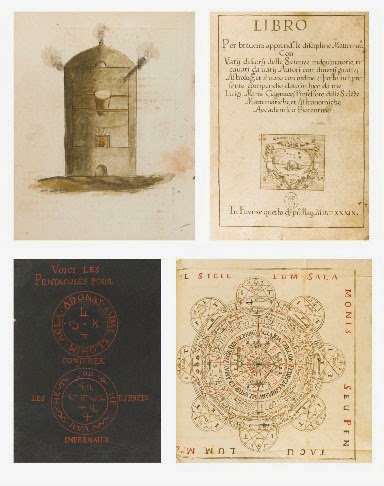
This collection of manuscripts upon a variety of themes including the occult, alchemy and natural science was compiled by General Charles Rainsford and is being offered by Sotheby's in London.
It is estimated to sell for £40-£60,000.
The catalogue description reads: comprising 58 manuscript copies of works on esoteric subjects including
alchemy, chiromancy, Hermeticism, Rosicrucianism, Kabbalah, Angelic
lore, ritual magic and conjurations, Paracelsianism, Tarot,
somnambulism, astrology, and natural science, in English, Latin,
Italian, French, and German, including 28 manuscripts in Charles
Rainsford’s autograph (chiefly English translations), as well as
manuscripts purchased by him and commissioned by him, including one in
the hand of Dr Ebenezer Sibly, many items illustrated with pentacles,
sigils, alchemical furnaces, and diagrams, many also with annotations,
indexes, or inserted notes by Rainsford, the great majority dating from
the late 18th century but a few earlier items, various sizes and
bindings, most items boxed, some with Rainsford’s ownership stamp and
most with a Northumberland bookplate,significantdamp damage to 15 volumes
Cape Town - On the grounds of Parliament, close to Tuynhuys in the heart of Cape Town, is an old, white, plastered building.
The Lodge De Goede Hoop is hidden behind a parking lot filled with shiny ministerial cars.
Only
the Freemason symbol on the window and the Star of David above the
large wooden doors show that this is not just another parliamentary
building.
The building was inaugurated as the first masonic temple in South Africa in 1803 and is still used daily by its members.
This week, City Press took a tour of the temple with the newly appointed Grand Master of the SA Freemasons, Geoff Edwards.
On
a table in the foyer are a square and a pair of compasses – well-known
masonic symbols. On the wall is an engraved list of the names of former
masters and the wall beside the front door is adorned with a framed
photograph of Watty Watson, former DA chief whip and retiring Grand
Master.
“People say we’re on parliamentary grounds, but that’s not true. Actually, Parliament is on our grounds,” he says.
Edwards is right because this mysterious organisation has been in South Africa and Cape Town for much longer than Parliament.
The first Freemason lodge was formed in Cape Town in 1772 and the temple was built about 30 years later.
The
Cape government of the time and the Freemasons were so intertwined that
the Cape Parliament used the masonic banquet hall as a venue from 1854
to 1884 until the old House of Assembly was completed.
The
organisation, regarded as among the most mysterious in the world, is all
about money, power and secret handshakes, its detractors whisper. There
are many conspiracy theories, alleged links with murders, and those who
believe the Freemasons “planted the seeds” of apartheid.
Others
say that from the organisation’s inception in the 14th century, it has
been the secret hand that is quietly ruling the world.
Not true,
according to Edwards, taking us into the meditation chamber with its
sinister statue of a dead man with a dagger, a book and an hourglass,
and the words “know thyself”.
Two artificial human skulls add a
chilling edge to the room. “People say the Freemasons have ruled the
world over the centuries, but the truth is that many rulers were simply
masons,” he says.
But where do secret handshakes and rituals fit
in 2014? “I’m reluctant to use the word ‘secret’,” says Edwards, a
businessman who runs his own recruitment agency.
“We don’t make
the way we operate known publicly because that will spoil things for the
candidates, but we aren’t trying to hide ourselves from the world.
“Like
many other organisations, we have been attacked aggressively in the
past. During World War 2, Hitler tried to wipe out the Freemasons.
“Even
in South Africa, there was a time when we were targeted. That made our
members cautious. Nowadays, we encourage members to speak about it. The
world has changed,” Edwards says.
The most fascinating room in the
Lodge De Goede Hoop is undoubtedly the middle chamber. With only two
small windows letting in a sliver of light, the room is dark even in the
middle of the day. Here, ceremonies are held at night in the pitch dark
to remind members just how fleeting their lives are.
The
organisation is open to all races, but does not accept women as members.
There are female lodges in some parts of the world, but they are not
recognised by the Freemasons’ constitution. No atheists are permitted to
join. Members believe in the “life hereafter”, so atheists aren’t
welcome.
“To become a member, the person is required to believe in
a ‘higher power’, but we do not say who that must be. Freemasonry is
not a religion. We offer no path to heaven.”
Edwards says the Freemasons believe in tolerance, and promoting peace and harmony.
“In
our lodge we have members of Parliament from three different political
parties and they all get on tremendously well together,” he boasts.
Then, with an almost disappointingly ordinary handshake, he says goodbye.