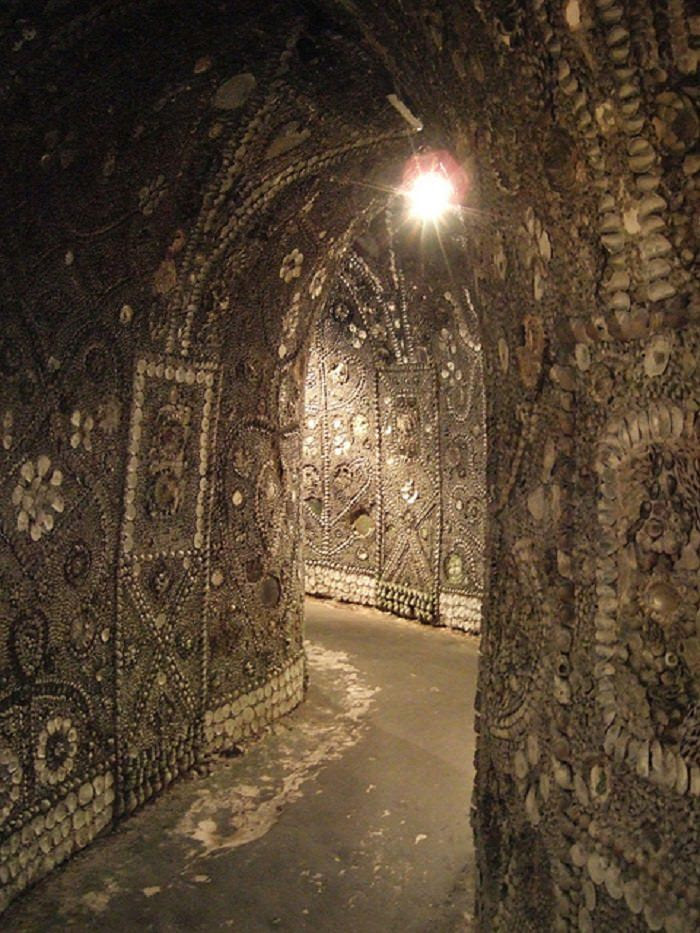
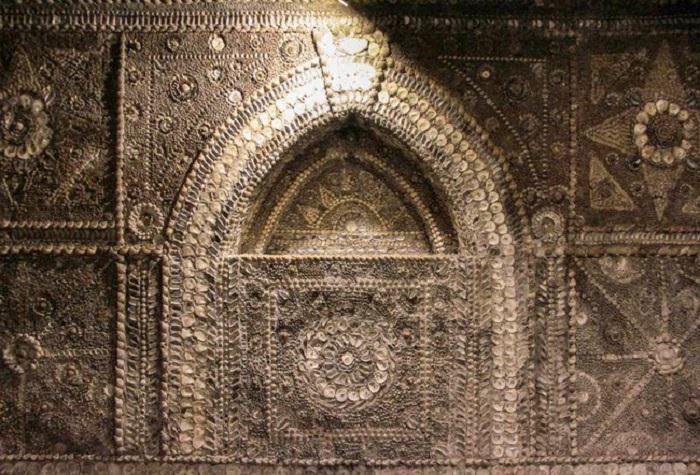
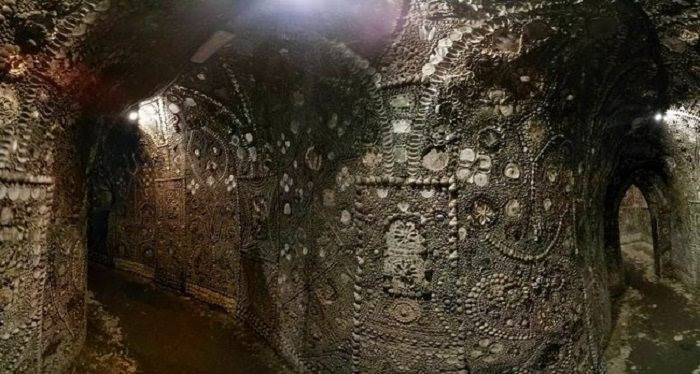
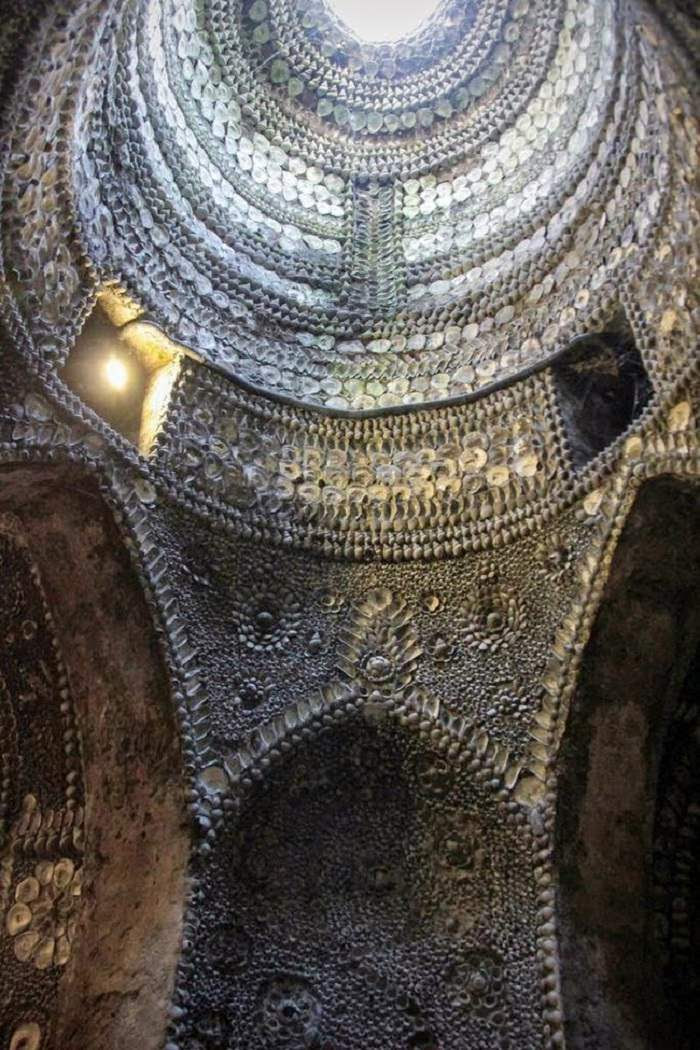
Buried deep underground in small English town of Margate, Kent; is a grotto shrouded in complete mystery. Adorned with 4.6 million shells and 70ft of winding underground passages leading to a rectangular chamber, this shell grotto is undoubtedly a remarkable site to behold.
Story has it that in 1835, a laborer was going about his usual field work, but when he struck the soil with his spade, it sank into the earth. The farmer realized that he was standing on something hollow, but was unable to see anything from the surface. Word spread around town, and a local school teacher volunteered his young son, Joshua, to be lowered into the hole with a candle. Upon emerging from the mysterious cavern, Joshua described rooms filled with hundreds of thousands of carefully arranged shells.
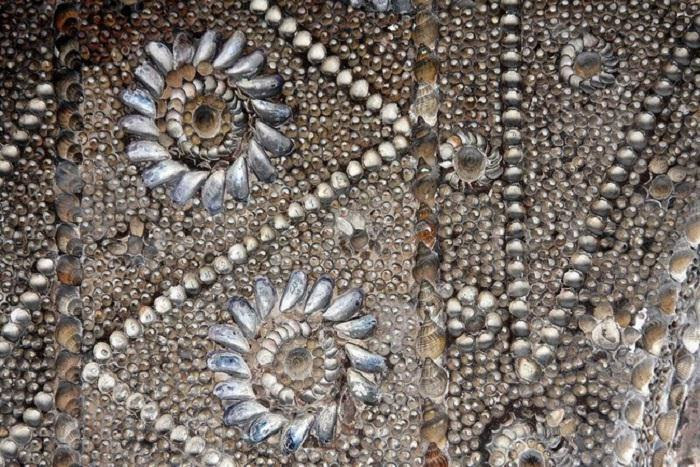
The Shell Grotto is adorned with symbols mosaiced in millions of shells, symbols that celebrate life as well as reminders of death.
The Shell Grotto hosts a passage, a rotunda and an altar chamber.
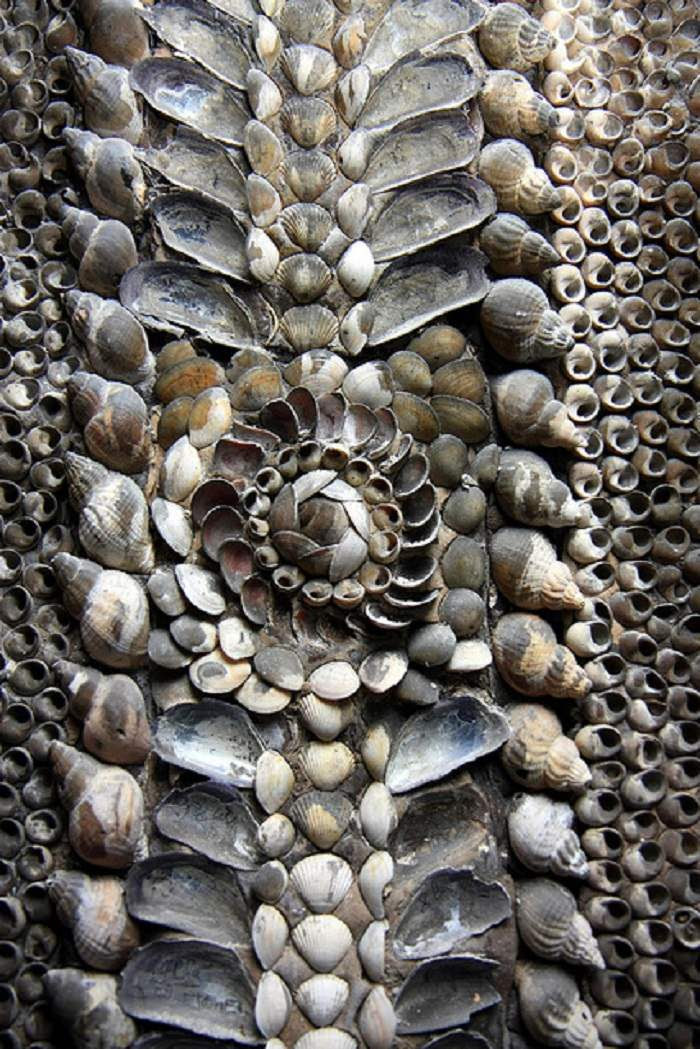
The shells in the grotto, include scallops, whelks, mussels, cockles, limpets and oysters, all of which can be found locally. However, the flat wrinkle shells must have been brought in from elsewhere.
With so much intricate detail, on a rather large scale, one question still remains, who built this underground cavern?
Shrouded in mystery, some believe that the grotto once had religious significance - primarily due to the vaulted ceilings and altar spaces.
Nobody knows how old the grotto is, but some theories about its origin date its constructions as far back as 3,000 years ago.
Another theory holds that the grotto was created as an aristocrat's folly sometime in the 1700s. This proposed explanation is validated by the fact that shell grottoes were actually quite popular in Europe in the 1700s, especially among the wealthy. The only catch to this theory, though, is that the grotto's location was on farmland - a land that had never been part of a large estate where follies would have been satisfied.
Others believe that it may have been used as an astrological calendar in the past.
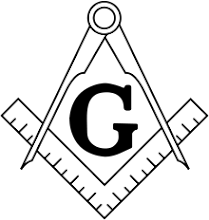
There are those also, who say that the grotto must somehow be connected with the Freemasons or the Knights Templar.
Others believe that the grotto may date as far back as 12,000 years ago, maintaining that it is connected to a mysterious Mexicanculture.
Its mystery has left people completely stumped, so much so that in the 1930s, some had held séances, in the hopes of contacting the spirits of whoever built the grotto.
Right now, it seems, we will not discover the truth behind this mysterious shell grotto. The age of the shells could be determined through carbon dating according to the Shell Grotto's web site, but it's a pricey process and other conservation issues are currently being prioritized.
One thing is clear though, the arrangement of the shells must have taken countless hours of painstaking work.
Unfortunately, many of the shells in the grotto have faded over time, losing their luster through water damage. In its early days, it would have been full of dazzling color. This recreation shows what they might have looked like at the time, and with over 4.6 millionshells, it surely must have looked astonishing!
Since its discovery, the Margate Shell Grotto has been opened to the public, first by Joshua's father, the school teacher. In 1835 he quickly bought up the land and began renovating the grotto to make it suitable for visitors. Two years later, in 1837, the grotto had been opened to the public for the first time, and still enjoys visitors today.
The most senior freemason in South Wales has defended the secretiveness of Wales’ 13,000 masons.
Provincial Grand Master Gareth Jones said the members of the order should not be forced to declare their membership.
He was responding to calls made by South Wales Police and Crime Commissioner on S4C’s Y Byd ar Bedwar current affairs programme for more openness.
Alun Michael argued that it should be compulsory for all public servants, whether police officers, council officials or politicians, to declare if they are freemasons.
But Provincial Grand Master Jones said it was “a little offensive” for anyone to be instructed to declare their membership.
“I see no reason at all why individuals should have to declare membership of freemasonry,” he told Y Byd ar Bedwar.
“I and my members in South Wales are happy to tell people that we’re freemasons and celebrate that.
“I think it’s the fact that one is being instructed to declare one’s freemasonry that is a little offensive.”
He said the society “makes good men better men” and is striving to become more open and transparent.
Although the masons allowed S4C cameras to film ceremony rehearsals, the ceremonies themselves were out-of-bounds.
“We’re not a secret society, “he said.
“Our ceremonies are established as a series of dramas intended to teach the brother as he becomes to be a better man.”
“The very small number of secrets we still have are simply modes of recognition.
“There is nothing sinister or mysterious about these. They are part of the play that candidates go through.”
Conspiracy theories
Mr Michael was First Secretary of the National Assembly when a law was implemented making it compulsory for AMs to declare membership of the society if elected.
As a minister in the Home Office at Westminster, the former MP also made police officers who were members declare, although this law was later challenged and overruled.
He said declaring membership of any society increases transparency and quells conspiracy theories.
“If members of a club or society have to disclose, it takes away any hidden agendas,” he said.
“If freemasons don’t disclose, you can get whisperings of wrongdoing. Declaring gets rid of all that.”
Public bodies all have different policies on staff or members declaring their membership of the masons.
Voluntary disclosure
In Westminster, MPs don’t have to disclose membership. In Cardiff Bay, AMs are expected to declare but no current member has done so.
In local authorities, the rules are unclear, with policies varying between authorities. Just 25 councillors across Wales have stated they are members.
Dyfed-Powys Police and Gwent Police have no requirement for staff to declare membership of the freemasons.
But both North Wales Police and South Wales Police operate a voluntary disclosure system.
South Wales Police told Y Byd ar Bedwar that two officers and three civilian support staff have declared membership whilst in North Wales, three sergeants and six constables have stated that they are freemasons.
Mr Michael said: “It would be best to have one common system for local authorities, police force and health boards. Only then can we ensure everybody is being treated equally.
Freemasons have been barred from working on the investigation into the alleged Hillsborough 'cover-up'.
The Independent Police Complaints Commission (IPCC) is currently investigating claims of a cover-up following the death of 96 Liverpool supporters in Britain's worst ever sporting disaster in April 1989, along with managing the biggest ever criminal investigation into police criminality.
The IPCC decided at the outset of the investigation that Freemasons may not be employed as civilian investigators on work relating to Hillsborough, despite a court ruling which banned discrimination against members.
Mr Duckenfield himself confirmed when giving evidence last March that he became a Freemason in 1975 and became 'Worshipful Master' of his local lodge in 1990, a year after the Hillsborough tragedy.
He denied his position within the Freemasons had helped his promotion to chief superintendent and any involvement in a 'cover-up'.
An IPCC spokesperson said: “As part of its independent investigation into the aftermath of the Hillsborough disaster, the IPCC is examining whether there was any form of influence on the decision making of police involved in the disaster, arising from the membership of any organisations or groups.
"The IPCC has policies in place which are aimed to maintain the integrity of our investigations and to ensure there is no actual or perceived bias.
"These policies apply to all our investigations, including Hillsborough, and when implemented may exclude certain individuals from working on specific investigations in order to avoid there being any actual, or perceived, conflict of interest in relation to any aspect of the ongoing investigation.”
The United Grand Lodge of England, representing 200,0000 freemasons across the country, said it was fully cooperating with the commission’s inquiry and did not believe that the ban was necessary.
A spokesperson said: “We strongly urge that there is total transparency [in the inquiry]. We assume the ban is based on uninformed fears and it is totally unnecessary. Our members see this as being a slight on them.”
The European Court of Human Rights ruled in 2007 it was unlawful to require freemasons to identify themselves when seeking public positions.
Century-old mystery is solved as experts confirm the final resting place of Rudyard Kipling's 'Boy Jack' whose World War One death broke the writer's heart
John Kipling died while fighting in the Battle of Loos in September 1915
His body was not found for several years and there was doubt over whether the remains were really his
Now experts say they can confirm that the body in his grave is John
Father Rudyard wrote My Boy Jack about him when he was in mourning
The mystery of what happened to Rudyard Kipling's son who vanished during a First World War battle has been solved more than a century later.
John Kipling - remembered in his father's poem My Boy Jack - went missing after he led his troops into action during the Battle of Loos in September 1915.
His body was not found until after the end of the war - but even then, it was not known for sure that it was really him rather than one of his comrades.
+5
+5
Grief: Rudyard Kipling, left, mourned the death of his son John, right, after he vanished during a battle
+5
Burial: This map pinpoints the location where Jack was thought to have been killed, where he was actually killed and where he was laid to rest
Now researchers say they are confident that his grave can be identified after all, claiming they have proven that he is buried in a military cemetery near the battlefield in northern France.
Jack was the only son of Rudyard Kipling, author of great works including If and The Jungle Book, and was educated at Wellington College until he was 16.
The teenager applied for an officer's commission when war broke out, but was turned down because his eyesight was too bad.
After an intervention from Field Marshal Lord Roberts, a friend of his father's, Jack landed a position with the Irish Guards.
+5
Grave: This is the final resting place of John Kipling, in St Mary's Cemetery in northern France
BELOVED AUTHOR WHO NEVER GOT OVER SON'S MYSTERIOUS DEATH
Rudyard Kipling's novels, poems and children's books made him one of the most beloved authors of the Victorian and Edwardian era.
He is best known for works such as the inspirational poem If, as well as The Jungle Book which chronicles the adventures of Mowgli, a boy raised by animals in the jungles of India.
Kipling had three children, of whom the only boy was John - and the poet always struggled to cope with his death at the Battle of Loos aged just 18.
As well as the poem My Boy Jack, widely thought to be a reference to his son, Kipling wrote the line: 'If any question why we died / Tell them, because our fathers lied.'
Critics have speculated that Kipling was wracked with guilt over his role in helping his son join the army, and he spent years trying to find out exactly what had happened to him.
However, the death of his son did nothing to change Kipling's fiercely patriotic and imperialist views.
He arrived in France on his 18th birthday, August 17, 1915, and just six weeks later he was commanding a platoon at the Battle of Loos.
Jack, who had recently been promoted to lieutenant, was known to be wounded but subsequently disappeared, and was still listed as missing by the end of the war three years later.
Weeks after his death, Rudyard Kipling wrote a poem about him which begins with the line: 'Have you news of my boy Jack?'
In 1919, the body of an unidentified Irish Guards lieutenant was found on the battlefield, and was buried in an anonymous grave at St Mary's Cemetery.
More than two decades ago, the Commonwealth War Graves Commission announced that the grave was in fact Jack's, and erected a headstone to him.
Critics immediately denied that it could be his, saying that the body was found three miles away from where Jack was last seen and claiming that he was still a second lieutenant on the day of the battle.
But researchers Graham Parker and Joanna Legg have now discovered new evidence which suggests that the identification was correct and that Jack's body is indeed buried in the cemetery.
+5
Adaptation: 2007 TV drama My Boy Jack, starrring Daniel Radcliffe, told the story of Kipling and his son
Writing in Stand To!, the journal of the Western Front Association, the pair reveal that the three-mile distance between Jack's disappearance and the body's discovery is nothing more than a mapping error.
In fact, the body was found close to where he was known to be fighting and was seen by witnesses shortly before his death.
Mr Parker and Ms Legg also prove that Jack's promotion to lieutenant had come through before the battle, so he was wearing a lieutenant's uniform when he died.
The authors conclude: 'On the balance of probabilities, the Irish Guards lieutenant found on September 23, 1919 must be Lieutenant John Kipling.'
Rudyard Kipling's poem about his son is often thought of as one of the most moving pieces of verse to have come out of the First World War.
The poem gave its name to a 1997 play and 2007 television film exploring Kipling's relationship with his son. The screen adaptation starred Daniel Radcliffe as Jack.
'HAVE YOU NEWS OF MY BOY JACK?' KIPLING'S EMOTIONAL TRIBUTE TO SON
Family: John Kipling with his sisters Carrie and Josephine when they were children
This silk wall hanging was listed for sale by Dominic Winter in Gloucestershire. It dates from around 1870 and the catalogue description reads:
A printed silk wall hanging, circa 1870s, depicting Adam & Eve, a beehive, a scythe, an hourglass, and various other Masonic symbols, colour blocked in green, yellow, pink, and mauve, on a blue and white ground, lined with pale blue silk, and with hand-stitched pink border, some light staining and minor edge-fraying, 81 x 68.5cm (24 x 27ins) It had an estimate of £70-100.